


Sliding wardrobes, made to measure
Sliding doors run along the front of the wardrobe instead of swinging out into the room, so the bed or a chest of drawers can stand close to them. We make sliding wardrobes to the width and height of your wall, with shaker, painted or mirrored doors, and fit them with our own team.
5.0 from 79 Google reviews
Priest Furniture designs, makes and fits sliding door wardrobes for homes across Chelmsford and Essex, in its own workshop at Dukes Park, with the doors and the inside drawn for the room.
Sliding wardrobes we have made
Every one drawn for its room, made at Dukes Park and fitted by our own team. The captions say what went into each.
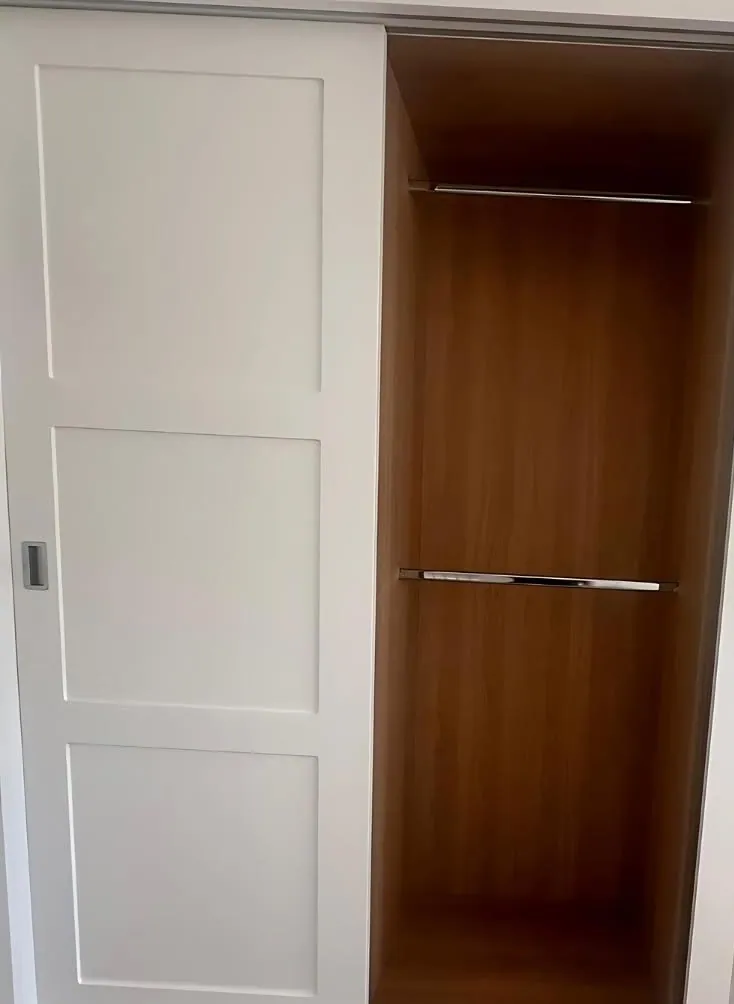
A shaker sliding door pushed aside to show two hanging rails in the oak-effect interior 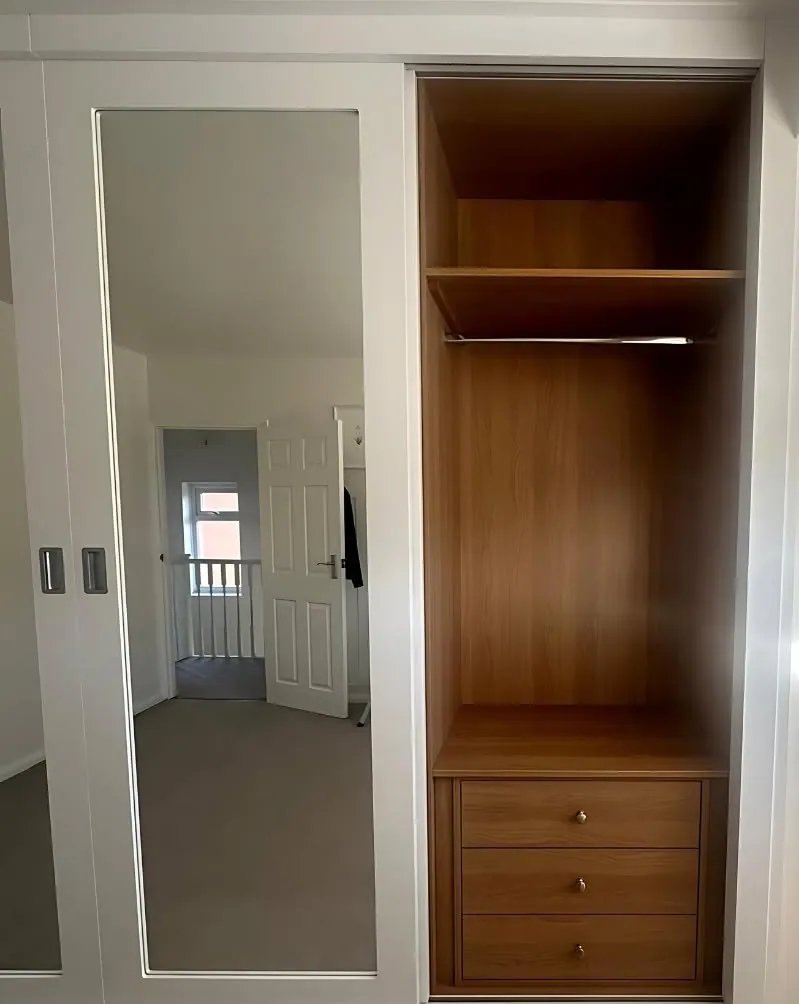
A mirrored door slid across to open the next bay: a shelf, a hanging rail and three drawers 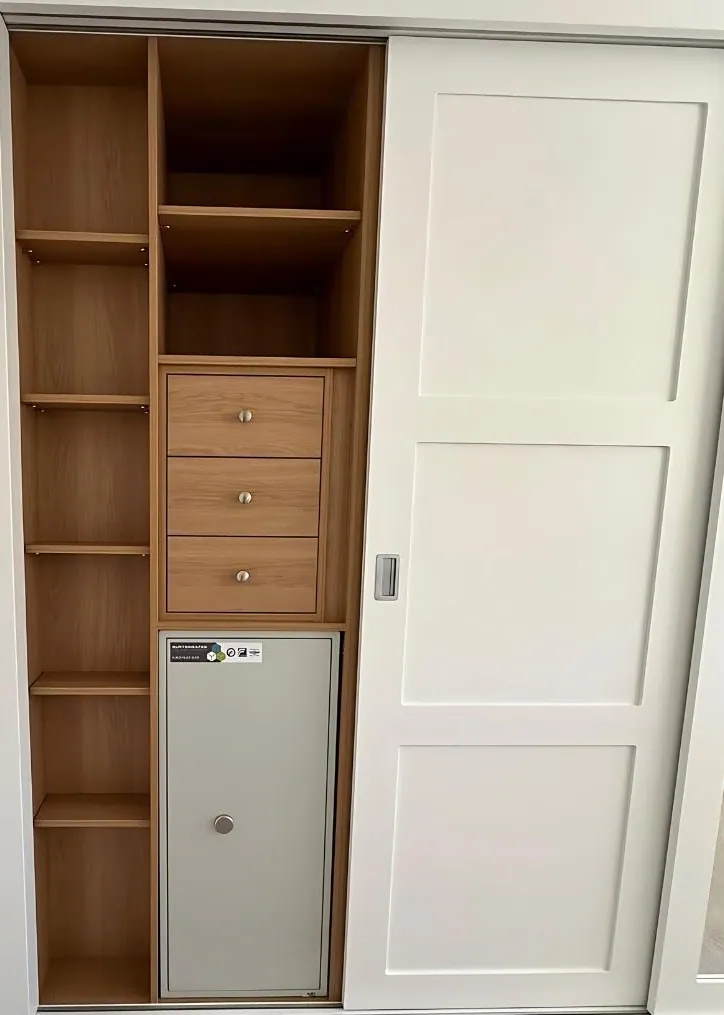
Open shelves, small drawers and a safe built in behind one sliding door 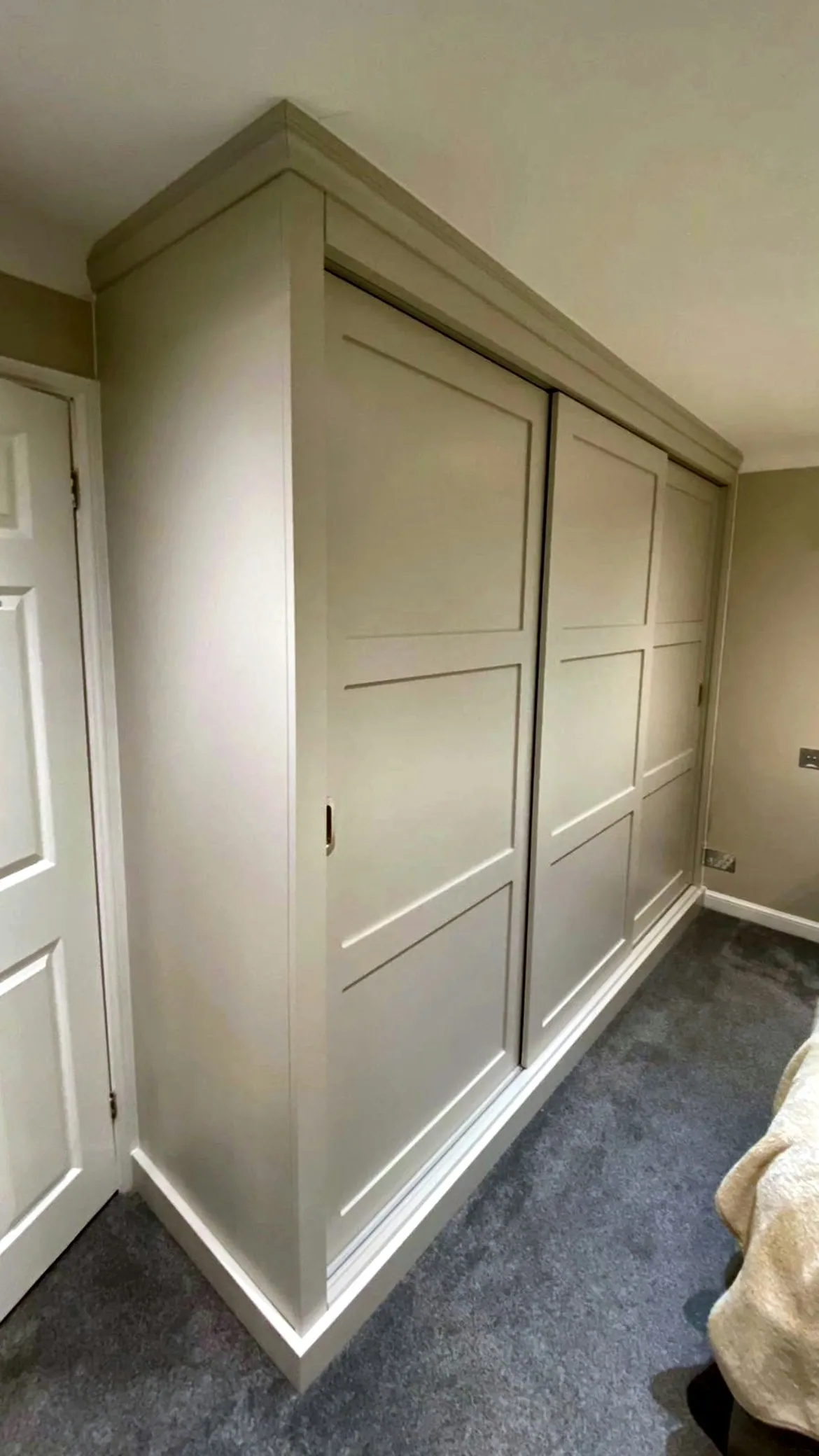
Sliding wardrobe painted in Morning Dew, running the length of a bedroom wall 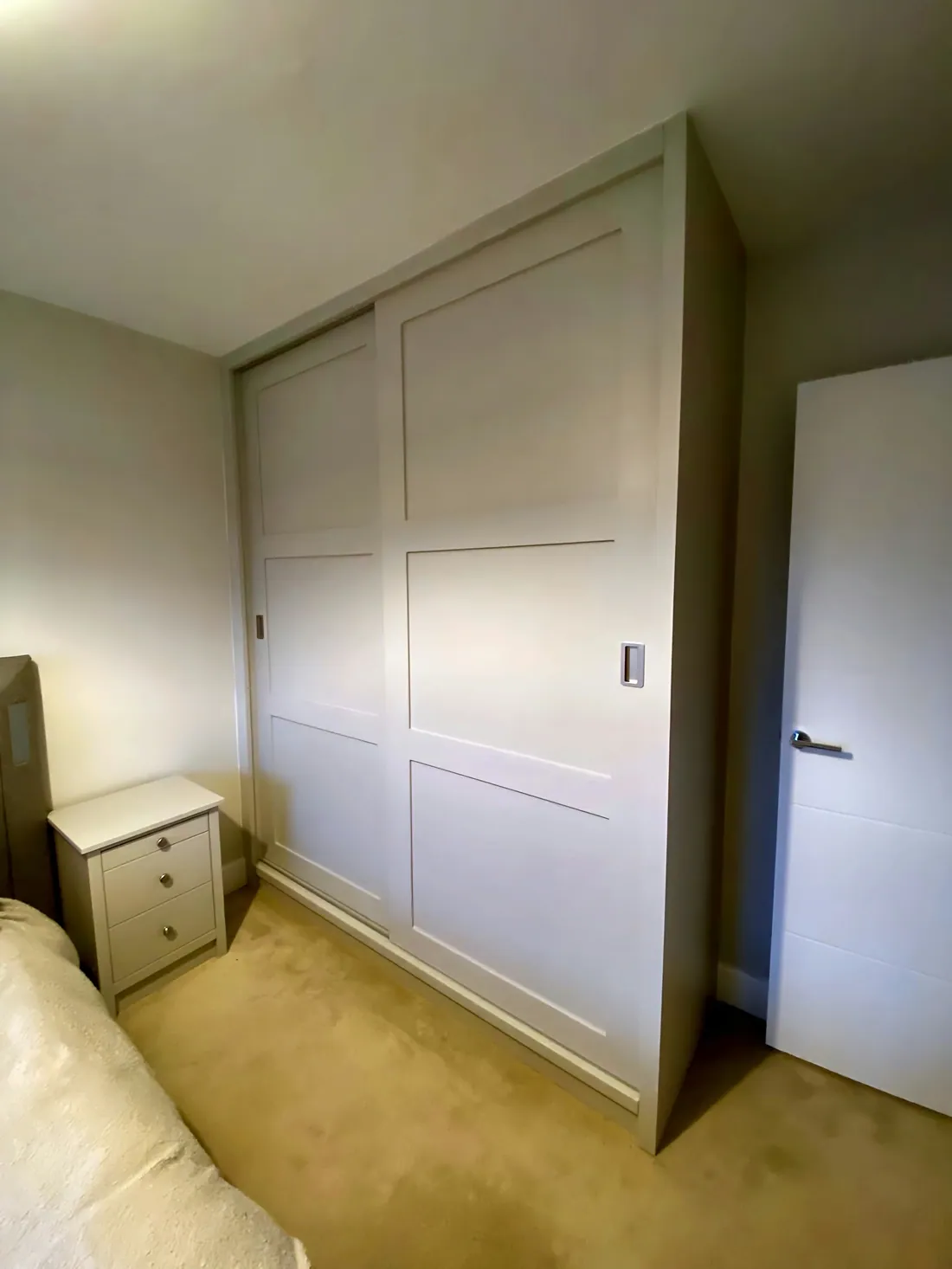
Two-door shaker sliding wardrobe in a bedroom, with flush pulls set into the doors


When sliding doors suit a room
A hinged door needs clear floor in front of it about as wide as the door itself, often 50 to 60 cm. A sliding door needs none. That usually makes sliding doors the better choice in a narrow bedroom, opposite the end of the bed, or beside the door into the room, where an open wardrobe door would block the way.
The trade-off is that only part of the wardrobe is open at any time. Behind two doors you see half of it; with three or four doors you open one door's width while the others stack in front of the rest. Hinged doors show the whole interior at once, and they cope better with a sloping ceiling: our guide to wardrobes under sloping ceilings covers those.
Planning the inside around the doors
Because the doors overlap, the inside is drawn bay by bay to match where each door stops. Drawers and pull-out shoe racks have to sit wholly behind one opening and far enough back that their handles clear the door running in front of them. A drawer that straddles two doors cannot be opened.
The white wardrobe on this page is planned this way: two hanging rails in one bay, a rail over three drawers in the next, and open shelves, small drawers and a safe behind the last door.
Depth, tracks and door widths
The doors run on tracks in front of the cupboard, which usually adds 8 to 10 cm to the depth. A sliding wardrobe is often 65 to 70 cm deep where a hinged one is about 60 cm, so it is worth measuring the room with that in mind. Our wardrobe dimensions guide has the usual sizes for hanging and shelves.
Doors are usually between about 60 cm and 1.2 metres wide. Narrower doors give small openings; wider ones get heavy to push. Tall doors need a top track that is level, so on an uneven ceiling a frame or a cornice above the doors takes up the difference.
Mirrored sliding doors
A mirrored door gives a full-length mirror without using any wall, and in a small bedroom it makes the room look larger. Mirrors can run across every door or sit between panelled doors, like the two mirrored doors between shaker panels on this page. Our mirrored wardrobes page shows mirrored doors of every kind we make.
What to decide first
- How many doors, which sets how wide each opening is.
- What goes in each bay: hanging, shelves, drawers, shoes or a safe.
- Panelled, painted or mirrored doors, or a mix.
- The colour, and whether the inside is lit.
What goes into yours
Everything is chosen with you at the design consultation and drawn before it is made.
From a conversation to a fitted room
Nothing is made until you have seen it drawn.
Design consultation and quote
Free, with no obligation
We meet at our showroom, at your home or on a video call. We measure, look at how the room is used, its alcoves, slopes and awkward corners, and talk through timber, finishes and budget. Then we send you a written quote.
CAD drawings
Once you pay a 35% deposit
Our design team draws your furniture in CAD so you can see it in the room before anything is cut. We can colour match to furniture you already own.
Made in our workshop
8 to 12 weeks, depending on the piece
Our makers build it at Dukes Park. We send you photographs as it takes shape, and you are welcome to come and see it in the workshop before it leaves.
Delivered and fitted
Fitted by our own team
Our own experienced fitters deliver and install it, on a day that suits you. The family that drew it is a phone call away afterwards.
Sliding wardrobes: your questions
Anything else, see all our questions and answers, or ask us on 01245 450259 or at the showroom.
Guides
Who makes bespoke sliding wardrobes in Essex?
Priest Furniture, a family firm in Chelmsford making furniture since 1950. Every piece is drawn with you, made in our own workshop at Dukes Park and fitted by our own team, across Essex, London and the counties around. Rated 5.0 from 79 Google reviews.
Will you take out my old wardrobes?
We usually ask you to clear out your old furniture before we fit. If you would like us to take it out and dispose of it, we can, for an extra charge.
Do you make sliding wardrobes?
Yes. We make and fit sliding door wardrobes to measure: drawn at the free design consultation, made in our workshop at Dukes Park and fitted by our own team.
How much do sliding wardrobes cost?
We price each one from the width, the number of doors, any mirrors and what goes inside. After the free design consultation we send you a written quote. When you go ahead, a 35% deposit starts the CAD drawings, which you check before anything is made. Our guide to what fitted wardrobes cost has the published UK figures.
Are sliding or hinged wardrobe doors better?
Sliding doors need no space in front to open, so they suit narrow rooms and walls close to the bed. Hinged doors open the whole wardrobe at once and suit sloping ceilings. If you cannot decide, we draw both.
How deep is a sliding wardrobe?
Usually 65 to 70 cm, a little deeper than a hinged wardrobe, because the doors run on tracks in front of the cupboard.
Can sliding wardrobe doors be mirrored?
Yes. We make mirrored sliding doors, either mirror on every door or mirrored doors mixed with shaker panels on the same run.
How long does it take?
Usually 8 to 12 weeks from the go-ahead to fitting.
Where we fit
Across London, and everywhere within about two hours' drive of our workshop in Chelmsford.
That takes in all of Essex and Suffolk, Cambridge and Norwich, Kent to Canterbury, Surrey and Sussex to the coast at Brighton, and west as far as Reading, Oxford and Northampton. Further afield? Ask us.